Personal Project
Induction Heating Device
Designed and built a custom ZVS (Zero Voltage Switching) induction heater from scratch — power electronics design, resonant tank circuit tuning, custom copper work coil fabrication, and ESP32 embedded control with temperature monitoring and safety interlocks. Heats ferrous metals to cherry red (~800°C) in seconds.
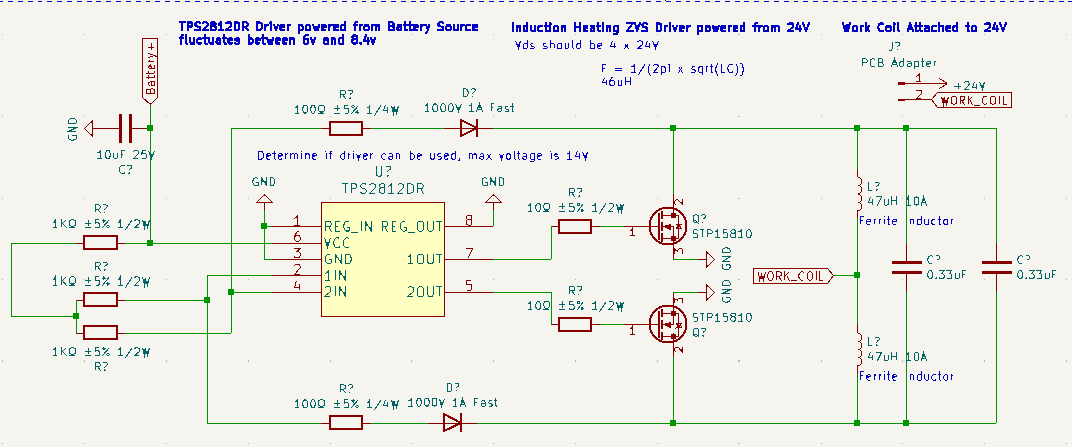
Designed the ZVS oscillator circuit around a Mazzilli driver topology — a self-oscillating half-bridge inverter that achieves zero voltage switching (ZVS) for high efficiency. The circuit uses dual IRFP260N MOSFETs (200V, 50A) driven by a center-tapped choke inductor that automatically alternates gate drive between the two transistors. The resonant tank consists of a 0.47µF polypropylene capacitor bank (3 × 1.5µF in series for voltage rating, paralleled for current handling) and a 5-turn copper work coil wound from 6mm refrigeration tubing for water cooling. The LC tank resonates at approximately 90kHz, producing an alternating magnetic field that induces eddy currents in ferrous workpieces.
Built the power delivery stage with a 48V 30A switch-mode power supply providing approximately 1.5kW to the resonant tank. Added a soft-start circuit using an NTC thermistor to limit inrush current during capacitor charging. Input protection includes a 30A blade fuse, reverse polarity protection via a series MOSFET, and TVS diodes for voltage transient clamping. The work coil is fabricated from copper tubing with brazed water cooling fittings — water flows through the coil during operation to prevent copper annealing at high power levels. A flow switch interlocks the power supply, cutting power if cooling water stops.
Developed ESP32-based embedded firmware for temperature monitoring and safety control: a K-type thermocouple with MAX6675 SPI interface reads workpiece temperature at 250ms intervals, displayed on a TFT LCD screen with real-time temperature graph. Safety features include configurable temperature cutoff (auto power-off at target temperature), duty cycle limiting (prevents continuous operation beyond 60 seconds without a cooldown period), and over-temperature shutdown for the MOSFET heatsink via an NTC sensor. The ESP32 controls the main power relay via an optocoupler-isolated gate driver, providing galvanic isolation between the control electronics and the high-current power stage.